- TOGETHER 1
- Research on the “contact-free medical treatment system” launched
본문영역
Launch of research on “contact-free, remote treatment system,”
Smart healthcare-based
digital talent promotion
UNIST is leading the development of a convenient system, by which users can check their health/ physical conditions without going to the hospital when they have some health issues. Research on an anytime-anywhere contact-free, remote treatment system has started. We have our report on the plan for the 5T SPACE Center which will provide in-depth convergent education and promote the ICT talents required for local communities
The 5T SPACE Center,
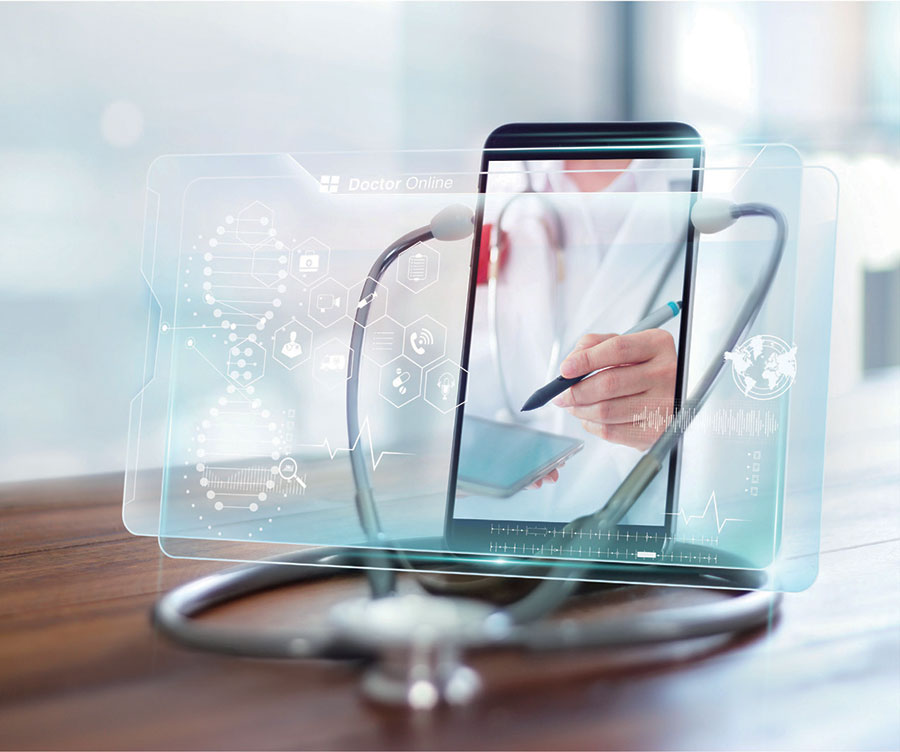
Building a rapid and accurate treatment system
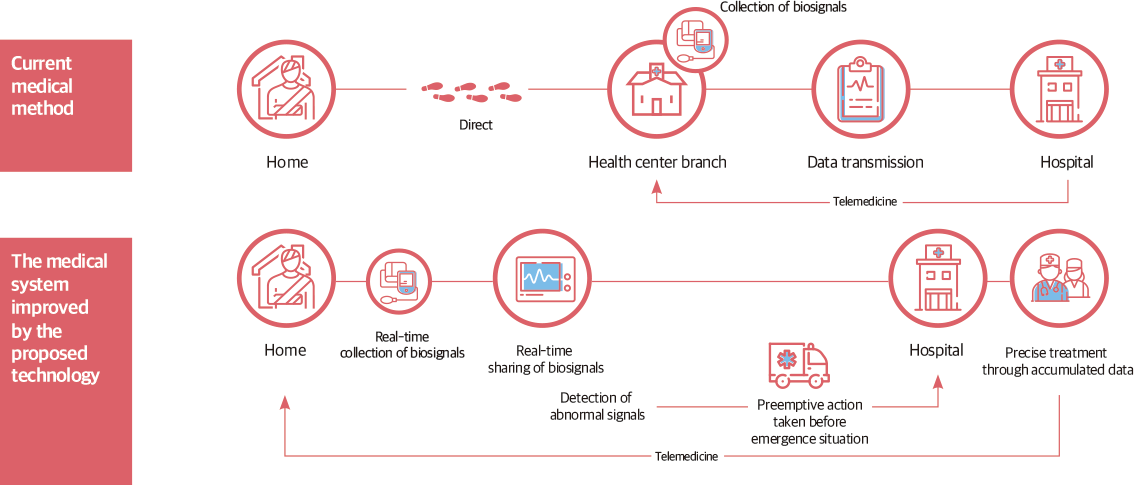
In the future beyond the current healthcare system, in which patients go to the hospital to collect biosignals, if we can check our body status anytime, anywhere without going to the hospital, the mortality rate will be lowered, and more careful management will also be possible. Moreover, if we implement a system that can do real-time monitoring and telemedicine by measuring various biosignals such as blood pressure, pulse, and blood sugar with a single device and securely sending them to the hospital, it would provide a more convenient treatment environment. To build such a convenient and efficient treatment system, the “5T SPACE Center” starts research on an contact-free, remote treatment system.
This center, hosted by the Department of Electrical Engineering in UNIST, contributes to the goal of “developing of 1 million digital talents” promoted by the government. The overall supervisor of this project is Professor Franklin Bien. The expectation of the contact-free, remote treatment platform using bio big data processing and handling technology and the integration system developed by the Center will be great for society, so this research project will be highly welcome.
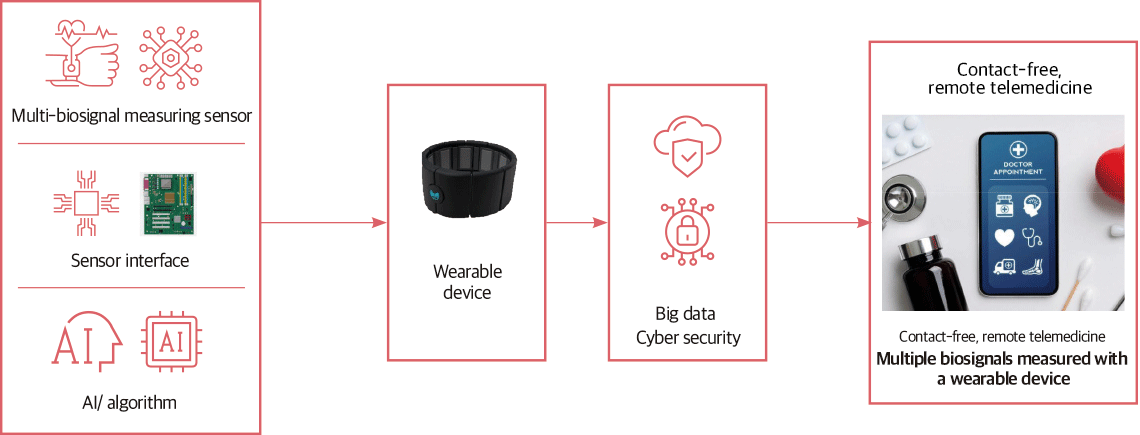
The 5T SPACE Center will develop a system that can do real-time health monitoring and telemedicine based on the measurement of multiple biosignals using a single wearable device. Currently, biosignal measurement technology is widely used through two options of pulse and blood pressure measurement or using a blood glucose meter. However, both options have a limitation of not being able to send data continuously to a doctor in real time. Thus, a real-time monitoring system of multiple biosignal data is needed urgently.
The Center will develop a sensor material, which is comfortable for skins, and design AI algorithms to prevent many measured signals from being mixed. It will also focus on dealing with the security of personal information as well as data transmission and reception.
To do this, it will promote detailed tasks such as multi-biometric signal sensor and system development (system-on-a-chip (SoC)), biosignal data analysis with transmission/ reception, AI algorithm with real-time monitoring, and a contact-free, remote telemedicine system. To perform these detailed tasks, 10 professors and 44 researchers at UNIST, Kyungnam University, and Changwon University will participate.
Overview of the 5T SPACE Center
Improving hands-on competence through the operation of the degree course
‘Regional Intelligent Innovation Talent Nurturing Project’
UNIST will provide an opportunity for small and medium-sized ICT companies in the southeastern region of Korea to enhance hands-on competency and understanding of the market by running a masters's degree course in engineering. The curriculum is composed of subjects that teach essential technologies in the smart healthcare-based intelligence industries such as wireless communication, sensor materials, semiconductor design, and AI. The “real-time biosignal monitoring and contact-free, remote medical services” developed at the Center is expected to also be used in improving the health of the elderly living alone, preventing the spread of the virus, and the contact-free, remote veterinary system. In addition, various talents in the 5T areas are expected to contribute to leading the innovation of regional industries.
The research on the multi-biosignal-related ICT technology and contact-free, remote telemedicine system will also have a positive impact on the development of the smart healthcare field, which is a future growth engine industry in the southeastern region of Korea including Ulsan.
To do this, a manpower training program will be instituted to select top-performing students, and specialized training courses through internships will be provided. An ongoing opportunity for education will be provided for lifecycle manpower development through higher education as well as constant joint research after employment. The master’s degree course for incumbent employees is also run as a project-centered talent development program. In this way, we are striving to lead the way in educating and training industry-fusion talents required by regional companies through the master's course for incumbent employees, which will produce 20 graduates a year. The 5T SPACE Center will operate for eight years based on the above-mentioned various talent development plans.
The Proposed Biosignal Measurement System