- START-UP
- Special Theme _ SEMICONDUCTOR
본문영역
High arithmetic efficiency with
ultra-low power consumption is realized
with ternary AI semiconductors.
Ternell
The AI market has been transformed greatly since the emergence of AlphaGo in 2016. AI with voice commands and operations using smart devices is everywhere. Now, various endeavors and technology developments such as smart sensors, self-driving cars, and robots are gaining ground at scale. What is the required semiconductor in this era? Professor Gyeong Rok Kim in the Department of Electrical Engineering has the answer.
ultra-low power consumption is realized
with ternary AI semiconductors.
Ternell
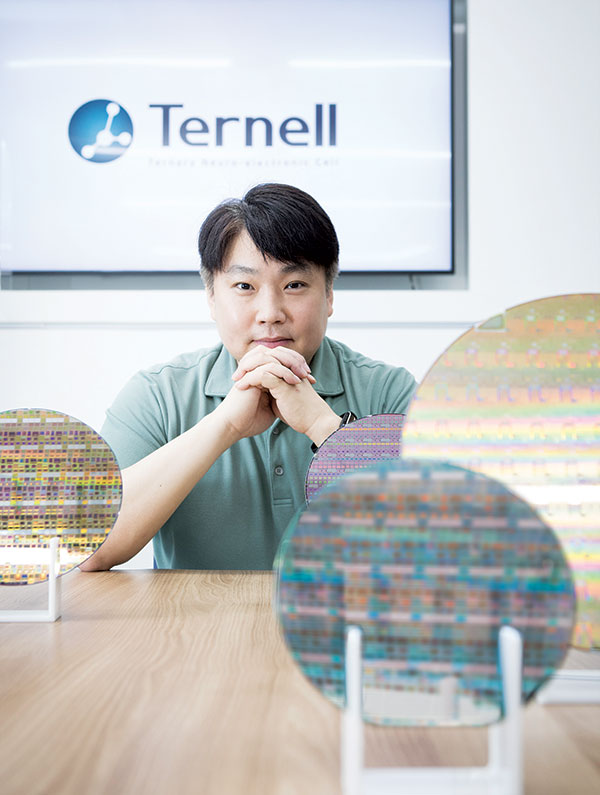 Gyeong Rok Kim
CEO of 'Ternell' (Professor of Electrical and Computer Engineering Department)
“As semiconductors are interconnected to acquire and process information, the execution can be much faster. Multitasking is also now possible mimicking how a human can do many tasks at the same time. This is the true meaning of AI technology and the direction that Ternell likes to go.”
The company name is Ternell. What does it mean?
A. __ It is an abbreviation for ternary neuro-electronic cell. Ternary means consisting of 0, 1, 2, or -1, 0, 1, and is evolved from the current binary consisting of 0 and 1. We borrowed the ternary logic. The term neuro-electronic cell is a newly coined word to mean the most basic unit of AI. Ternell is a company that develops and researches an optimization method of the AI semiconductor system, which has been designed in the binary system up until now, based on the ternary logic system, while manufacturing mass-production semiconductor chips.
Is there any reason why you chose a -1, 0, 1 system among ternary systems?
A. __ A 0, 1, 2 system numerically increases from 1 to 2, so the required energy also increases. The technology we pursue requires low power and high efficiency so it was not fit for our purpose. Alternatively, in a -1, 0, 1 system, energy is also cut in half so it has the advantage of being able to operate at energy levels where little power flows. With this advantage, we may overcome the limitation of current AI use that must be connected to the internet. AI services can be exchanged directly in offline edge devices with low power consumption. So, we thought its use value will improve much more than before.
Then, why it should be ternary?
A. __ AlphaGo consumed around 170㎾h energy to play the game go. This is equivalent to the required amount of energy that can operate 65,000 electric rice cookers.
In contrast, Lee Se-dol spent only 0.02kWh. In a simple calculation, AlphaGo spent 8,500 times more energy than Lee Se-dol. Basically, AI robots are binary-based, but the human brain uses a ternary number system. The difference cannot be underestimated. If that amount of information is to be integrated into binary format, the size of the semiconductor chip must be enormous. The human brain can incorporate petascale information of about 1014 bytes. If we implement this in binary, a chip size should be 30cm, which is the size of the wafer diameter. If a single chip size is that large, how big should the hardware be? We see little prospects for commercialization. However, if we make this in ternary, we can dramatically reduce the size.
Then, you may ask if the quaternary or pentagonal system would be better. But, there is a band that can differentiate a state called noise margin in a semiconductor chip. If we use a ternary system, this band gap will be shorter compared to using a binary system. If we use a quaternary or quinary system, this band gap will be shorter too, right? Simply speaking, it would be difficult to find something as the field of view becomes narrower. Similarly, as the band is shorter, more detailed work is required when doing error correction, etc., so we need a separate chip design to do this. When we add something more, it puts more burdens on the system. Considering this practical problem, we think that the ternary system is the most efficient for commercialization.
So does that mean more information can be put in the same semiconductor size? Then, what changes are you most expected?
A. __ The problem with binary semiconductors is that they cannot integrate more information anymore. If we integrate more, excessive heat is generated due to leakage current, so the chip will melt. It is the same as feeling the heat when we use electronic devices for a long time. Electronic products are plagued by a constant overheating problem. That is, we need to increase the number of chips if we want to put more information in a semiconductor. We may load a full range of equipment in the trunk of a currently tested self-driving car. Even with such a full range of equipment, is a self-driving car equipped with all required technologies? No. it is not. For example, the CMOS image sensor (CIS) camera is a great technology to make a car without blind spots by installing cameras with image sensors on side-view mirrors and transmitting the captured image to both side-view mirrors. But, if we use this in a self-driving car, we need other equipment. Even now, a full range of equipment is mounted in a car. A single piece of hardware the size of our palm is enough for a self-driving car if our chip is developed as we planned. Do car buyers like to buy a full range of equipment in a trunk? Or do they want to buy a car with equipment hidden somewhere and space available for another purpose? This problem must be solved if a self-driving car wants to be commercialized.
You mentioned commercialization a lot. Is that how you envision the AI ternary semiconductor developed by Ternell in pioneering the potential uses of AI and the lengths can AI go?
A. __ The purpose of electronic engineering is basically commercialization. It could be seen as pointless to develop a great new technology without any products brought to the market resulting from it. Because of that, we did not focus on simply the integration of large data volume but were concerned about how to reduce the size and noise. Up until now, IoT technology has just made electronic devices connected over the internet. However, ternary semiconductors is on track to advance to a stage where all electronic devices are connected with AI, which is called AIoT. For example, all components in not only self-driving cars but also smart and electronic vehicles can be made of semiconductors. As these semiconductors are interconnected to acquire and process information, the execution can be much faster. Multitasking is also now possible mimicking how a human can do many tasks in tandem. This is the true meaning of AI technology and the direction that Ternell likes to go.
Then, how far has AI ternary semiconductor technology come? Do you have any future roadmap in mind?
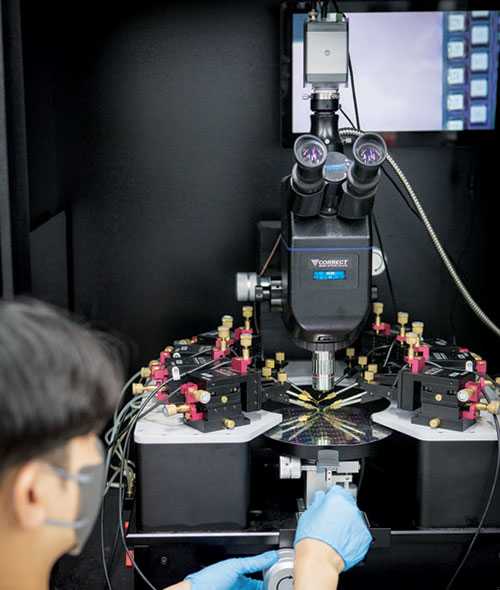
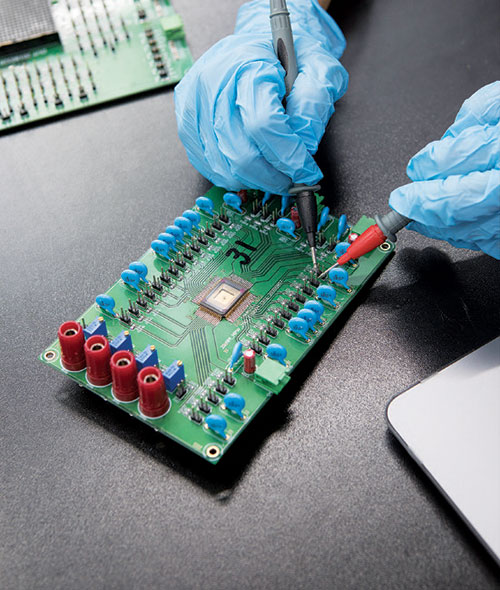
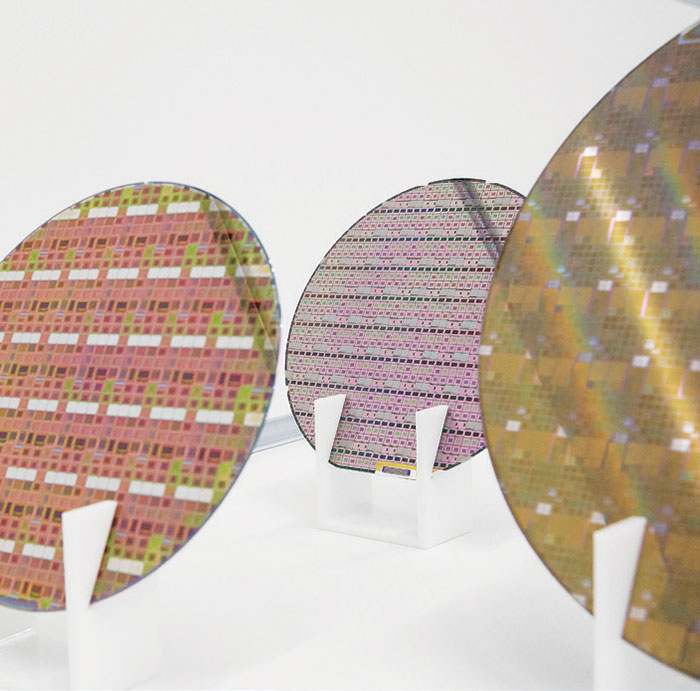
A. __ We have implemented a 28nm chip in the foundry, and verified semiconductors are manufactured even in a ternary state. Our goal is to make a wafer chip up to 3㎝×3㎝, which can contain petascale information. To achieve this goal, we have verified this twice a year in the foundry. We will strive for commercialization until 2025. In fact, many other fabless companies have only design patents. In contrast, we have manufacturing patents as well, giving us an edge in achieving commercialization faster.
Finally, can you tell us about Ternell's vision and your plan?
A. __ We have verified that our devised design can be fabricated in a real factory through our foundry. So, we will pursue more advanced technology. Ultimately, our vision is to develop a model that can imitate the human brain. Our source technology is a unique technology that can reduce power density and increase the volume of information, as well as the most certain technology that is directed to AI semiconductors. We would like to grow into a global leading company that may change the level and spectrum of AI by increasing memory performance continuously.