- OUTSIDE
- Special Theme _ SEMICONDUCTOR
본문영역
Why
emphasize semiconductors?
The new government administration pinpointed the future strategic industries as major government tasks, namely artificial intelligence (AI), semiconductors, and batteries. AI and batteries are heralded as the technologies to lead the Fourth Industrial Revolution, but you may ask why semiconductors are in the mix. Semiconductors have been the key technology that has led the economy of South Korea for the last 30 years since the 1990s. Then, why has the new government administration chosen the new task of being a “semiconductor superpower” as industrial policy again? What is the reason behind the global semiconductor trade war?
From transistors to AI semiconductors
Semiconductors are widely used in electronic devices which are essential in our daily life. They are used for various purposes by changing the property through the influence of heat, light, magnetic field, voltage, current, etc. The beginning of semiconductors was transistor technology.
A transistor is an element that plays the role of the switch to control a flow of current or voltage. Originally, it was a vacuum tube that amplified electronic signals in electronic devices that played this role before World War II. However, a vacuum tube consumed a large amount of power and had difficulty maintaining power. Thus, a technology to replace it was needed. Accordingly, the research team of William Shockley at Bell Laboratories in the U.S. developed a transistor whose conduction changed as the light was irradiated or electrons were injected. This invention was a very important turning point in the history of electronic engineering, which is regarded as the beginning of today's industrial development.
In 1958, Jack Kilby at Texas Instruments and Robert Noyce at Fairchild developed an integrated circuit (IC), on which various components are arranged and connected such as transistors as well as resistance, diode, capacitor, etc. in a single semiconductor (silicon) chip. An IC is thin, lightweight, and durable. It also opens the mass-production era as the whole circuit from components to connecting lines is packed in a semiconductor wafer.
The semiconductor industry, which emerged with the transistor and IC technology, has achieved breakneck growth as the number of transistors in a chip has steadily increased. The items are also refined and divided into memory, system, AI semiconductors, etc. Memory semiconductors are generally used to store and memorize information as the term indicates. System semiconductors serve the role of information processing such as data operation and control. They are also key components of autonomous driving, IoT, AI, cloud computing, and big data. AI semiconductors are optimized semiconductors using AI algorithms that output inference results based on trained data, and are regarded as semiconductors geared to only AI operations
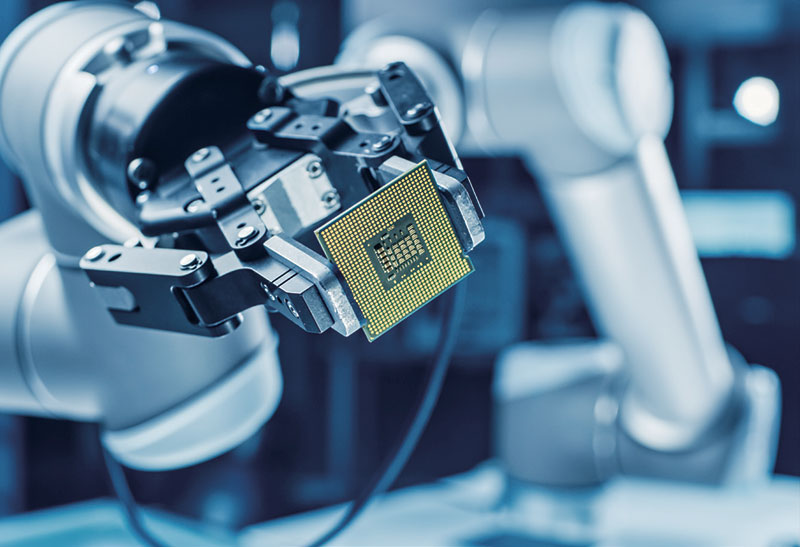
The key technology in the AI era
As AI emerges as the key technology that may be a game changer in the future industry, the predominant prediction is that the future system will move in the direction of AI replacing human labor in all aspects of life. Thus, it is essential to have advanced intelligence ability of AI such as learning, judgment, command, etc. More efficient and complex computing will be added naturally, and semiconductors will facilitate this. Compared to the human brain, the AI system is an algorithm of the brain and semiconductors are like the brain cells.
Early AI systems are used for machine learning as demonstrated by AlphaGo. However, AI systems will evolve in the direction of AI service implementation after inference work based on a large amount of learning data in the long term. To be able to achieve a level of inference that coincides with the human brain, semiconductor technology has to be advanced as brain capacity increases ultimately. The key semiconductor technology in the future will be nanometer (nm) ultra-fine process that handles 2 to 3/100,000 of the thickness of a hair, in addition to yield management, 3D device development technology beyond the current limit, etc.

Capture the hegemony of the global economy
Semiconductors are essential components in all cutting-edge industries such as supercomputers, electric vehicles, batteries, and key products that determine future technological competitiveness. Whoever leads in semiconductor technology will determine the hegemony of the global economy. This is why the U.S. and China compete in all high-tech equipment sectors including AI to dominate the semiconductor market.
Semiconductors do not just bring benefits to industries and the economy, but also serve as the key to the defense sector, as it has emerged as a critical part of national security. Science and technology have played the role in changing weapon systems for a long time. It is also true that war has allowed the showcasing of the latest technologies. The future weapon paradigm is changing and developing in the semiconductor field based on advanced science and technology such as intelligent hyper-connected networks, multi-information-based monitoring systems, and AI-based manned and unmanned weapon systems.
This trend is also influencing global security as well. The national security of Taiwan which holds TSMC, the strongest in the semiconductor fabrication foundry sector, has emerged as a global key issue. The semiconductor industry is divided into design, development, and manufacturing. Foundry belongs to manufacturing. The process of semiconductor chips is conducted at a nano level (one-billionth of a meter). Thus, ultra-fine process technology is an important area with a high cost of operations and management. Because of this, even semiconductor companies rarely operate their own foundry. That said, the manufacturing process is required to commercialize semiconductors. It goes without saying that the competitiveness of a nation boasting a large-scale foundry company will be enhanced. Besides TSMC, other leading foundry companies are SMIC in China, UMC in Taiwan, and Samsung Electronics and SK Hynix in South Korea.
3Nanometer Wafer
Smaller scale, more information, and less power consumption
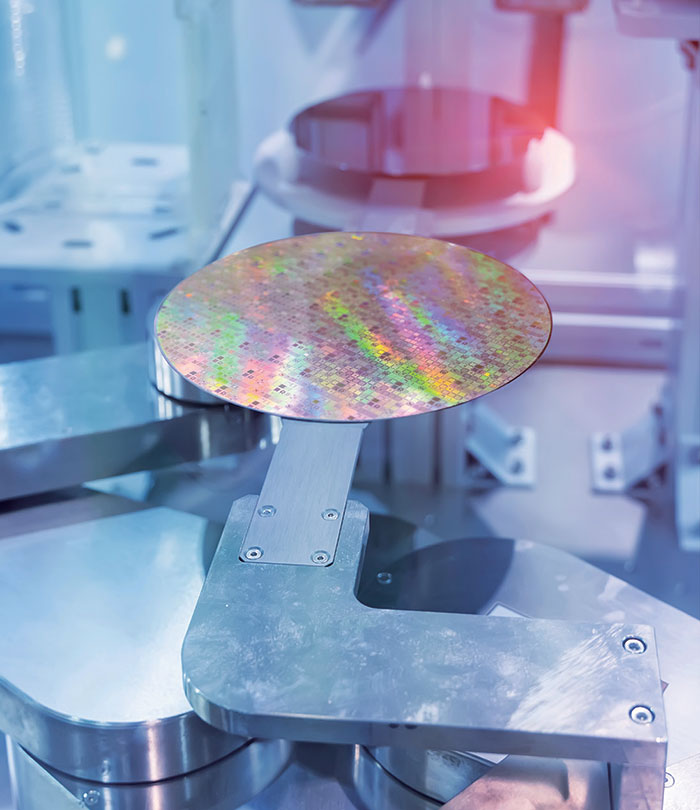
The battle of semiconductors is at a nano-scale level. Semiconductors are made in a much smaller scale/ realm than the thickness of hair strands. That said, companies are ceaselessly striving to make smaller semiconductor chips and integrate more information with less power consumption. Samsung Electronics has launched a semiconductor technology called Gate-All-Around (GAA)-based 3-nanometer wafer last May. This is the first case of successful mass-production using a 3-nanometer process, which employs the GAA structure and piqued global attention.
Up until now, semiconductor processes have applied the fin field-effect transistor (FinFET) technology to 3D structures. It improves semiconductor performance by increasing the contact point with the current flowing channel through the application of a 3D structure in a fish's fin shape. With the evolution to an ultra-fine process, the capability to finely adjust a current was required. Then the GAA structure was introduced where the current flowing channels are composed of four planes. GAA has the advantage of increasing power efficiency and high compatibility with the finFET process, achieving a high use value, because existing equipment and technologies can be employed without change.
AI, autonomous driving, IoT, etc. will require a different level of high performance than ever. This evolution is now taking place from the stage of executing a command to automatic execution through operations and inference. Three-nanometer semiconductors will be used in next-generation semiconductors while executing such a high-performance task with less power consumption.
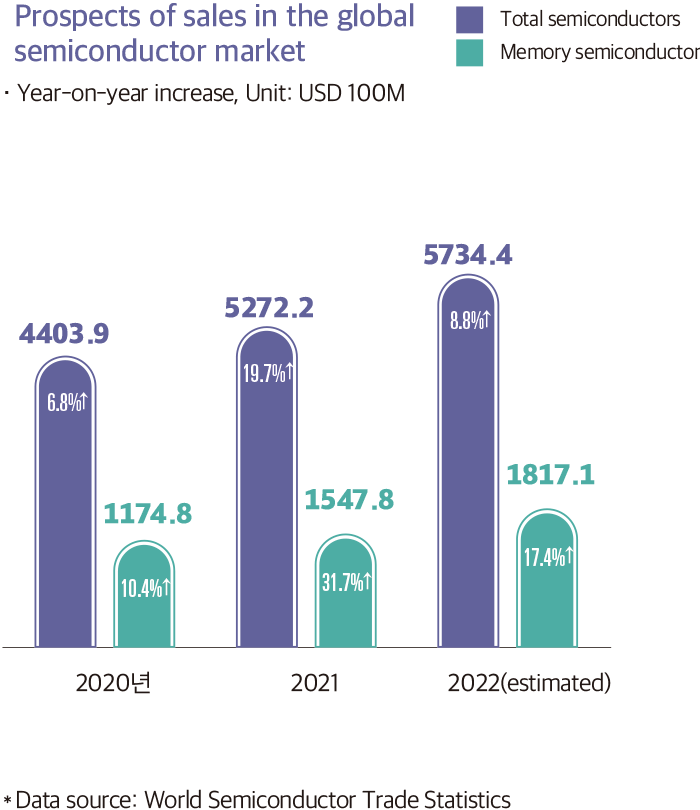
Meanwhile, the proportion of the semiconductor industry in South Korea has increased further. According to the Ministry of Trade, Industry, and Energy, nationwide exports as of 2021 reached KRW 644.54 billion, an increase of 25.8% compared to 2020. This is the largest export performance since 1956 when trade statistics began to be recorded. The exports in semiconductors also recorded their highest in history. The exports in semiconductors in 2021 stood at KRW 128 billion, an increase of 29% compared to 2020. This outcome was possible because our semiconductor industry has a competitive edge in manufacturing and production. However, we need an overall transformation in the long run. The semiconductor industry plays a large role of economic globalization, which is characterized by the international division of labor. The number of partners that deliver goods to a semiconductor company in the U.S. tallies 16,000, with more than half of them being overseas companies. This means that we need to broaden our horizons to not only manufacturing but also all stages of the semiconductor processes. The “K Semiconductor Strategy” was established at the national level in May last year, and aims to build a highly efficient industrial complex that integrates semiconductor production, raw materials, parts, equipment, advanced devices, and design at scale. The ongoing investment and efforts should be supported for South Korea to forge ahead to secure the largest market and production base in the global semiconductor industry and build a reliable and leading global semiconductor supply chain in the future.